Tokenomics
Japan Smart Chain token, JSC’s native token, serves a dual purpose within the Japan Smart Chain ecosystem:
-
JSC tokens function as the native token of JSC, powering the execution of smart contracts and blockchain applications.
-
Validator Client Operators and stakers stake JSC tokens and are rewarded in JSC tokens for their role in securing the network. Rewards in JSC tokens are earned at a target rate for the first ten years of the network being live, alongside transaction fees paid by JSC users.
Staking Ecosystem
The design of the JSC Validator Network consists of 21 Validator Client Operators, with validator client infrastructure all on-shore in Japan.
JSC wants to drive a robust staking/ownership ecosystem, with millions of companies and individuals in Japan via delegate and retail staking. Amongst the 21 validator clients, JSC will split the allocation between full node, delegate, and retail staking services.
For the first five-year phase from Mainnet launch (2025-2030), the 21 JSC validator clients will be allocated the following staking options:
| Node Type | Entity Type | Allocated Nodes | Stakers per Node | Year 0-5 Expected APY |
|---|---|---|---|---|
| Full Node | Nikkei 100 | 8 ~ 10 | 1 | 20% |
| Delegate Staking (Supported by trusted delegate partners)1 | Medium to Large Enterprises | 8 ~ 10 | 100s to 1,000s | 10%~ 15% |
| Retail Staking (Supported by AltX Research) | Small businesses and Individuals worldwide | 3 ~ 5 | Up to millions | Floating Rate |
| Total Validator Clients | - | 21 | - | - |
Table 1: Staking and Validator Ecosystem
Issuance
The total initial supply of JSC tokens has been set at 50 billion units.
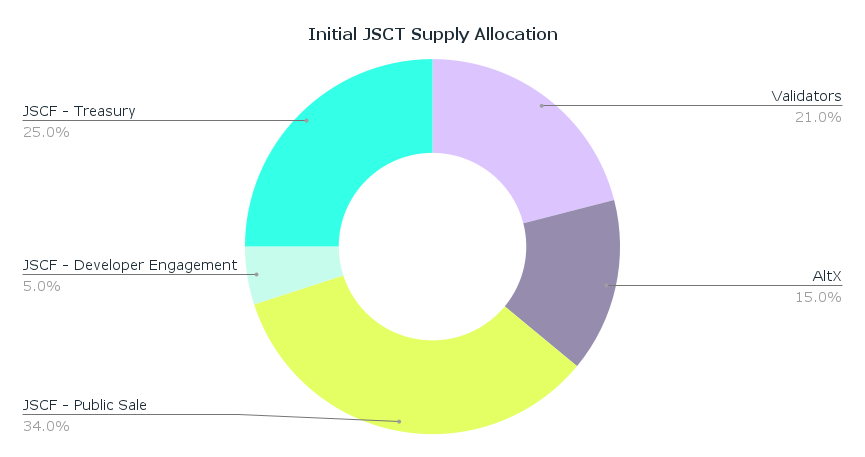
Below, we detail the JSC token allocation chart, outlining how the initial supply of tokens is distributed among different roles, each with specific vesting conditions and unlock schedules.
| Group | Allocation | Token units(in millions) |
|---|---|---|
| Validator Client Operators | 21% | 10,500 |
| AltX Research | 15% | 7,500 |
| JSCF - Treasury | 25% | 12,500 |
| JSCF - Public Sale | 34% | 17,000 |
| JSCF - Developer Engagement | 5% | 2,500 |
| Total | 100% | 50,000 |
Table 2: JSC token allocation
Validator Client Operators (21%)
Each Validator Client Operator (“Operator”) must purchase the minimum stake required to become an Operator, which is equal to 1% of the total initial supply. These tokens are deposited into the validator smart contract and will remain locked.
AltX(15%)
The AltX allocation is set aside as an incentive for the JSC founders, shareholders, developers, and core team members to recognize their contributions and align their interests with the project’s long-term success and growth.
JSC Foundation - Treasury (25%)
Of the initial token supply, 25% will be allocated to the JSCF treasure specifically earmarked for the Community Fund. This allocation is designed to support the growth and development of the JSC token ecosystem by funding community-driven projects, events, and initiatives. It serves as a financial reservoir to incentivize participation, foster innovation, and encourage the active involvement of community members in the project's expansion and success.。
JSC Foundation - Public Sale (34%)
Of the initial token supply, 34% will be allocated to the JSCF treasury for sale to the public on international and domestic exchanges. The Public Sale portion is the share of tokens that will be offered in tranches over time to investors. It provides access and liquidity to the JSC tokens, while the Foundation ensures this sale aligns with the JSCF mission. These tokens are not vested as this sale will be conducted through an exchange listing and offerings.
JSC Foundation - Developer Engagement Fund (5%)
The Developer Engagement allocation distributes tokens to new and existing JSC community developers to increase participation in JSC Layer 1 development and application development - including but not limited to the Mizuhiki Suite and other Japan-focussed compliance technologies - and to enhance token circulation, reward loyalty and further support developer engagement.
Issuance and Rewards
JSC stakers are rewarded for their active and honest participation in securing the network. For the first 10 years of JSC’s operation, stakers will earn staking rewards in the form of issuance rewards and transaction fees.
After 10 years, we envision a high level of transaction volume will be sufficient to reward validators for their securing of the network via transaction fees alone.
Issuance is set to decrease over time, with the goal of reaching zero after 10 years.
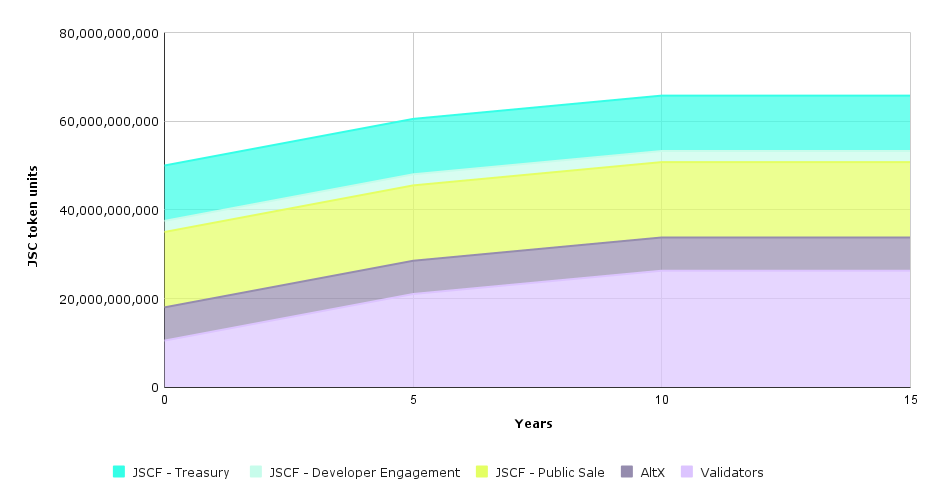
Given the JSC block time of 6 seconds2, the issuance reward will be 400 JSC tokens per block. Assuming each validator client has an initial stake of 500 million initial JSC tokens, thus a total of 10.5 billion JSC tokens across all 21 validator clients, the issuance rewards are as follows:
- Year 1-5: 20% APY issuance reward (2.1 billion JSC tokens issued per year))
- Year 5-10: 10% APY issuance reward (1.05 billion JSC tokens issued per year)
Full node stakers (i.e., JSC Validator Client Operators) will receive the entirety of their validator client's staking reward, while stakers in staking pools will receive the reward proportionate to their stake in the pool.
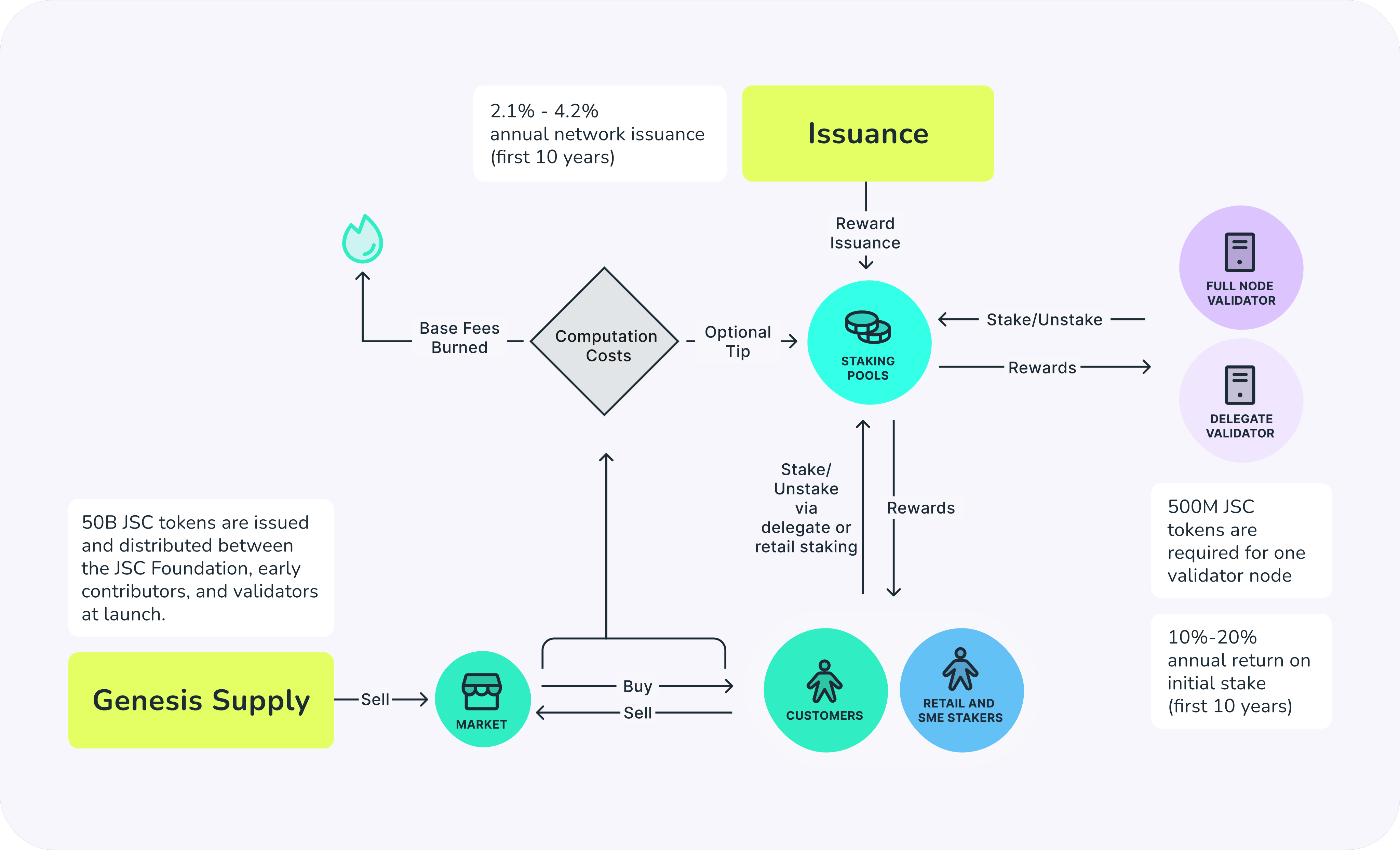
Blockchain transaction fees are paid by JSC users in JSC tokens. Like Ethereum, transactions will include a base fee to pay for the processing of the transaction, and an optional priority fee for transaction priortisation. Base fees are burned, or removed from circulation, to avoid collusion between validators and customers3.
The JSC Foundation is actively researching how transaction fees may be subsidized for stablecoins and other essential use cases through mechanisms embedded at the Layer 1 level.
The flowchart below breaks down the economic dynamics within the JSC ecosystem:
Footnotes
-
Both large and small companies in Japan may require assistance with the technical aspects of onboarding high-security blockchain infrastructure. Delegate staking, where technical and some accounting issues are handled by specialized third parties, is thus an important part of how we can develop a robust and active staking ecosystem. ↩
-
Average block time will be initially configured to six seconds, balancing the customer’s transaction speed with secure data propagation across the 21 validators. ↩
-
T. Roughgarden, "Transaction fee mechanism design for the Ethereum blockchain: An economic analysis of EIP-1559," arXiv preprint arXiv:2012.00854, 2020. [Online]. Available: https://arxiv.org/abs/2012.00854 ↩